Tips On How to Improve Your IELTS Writing Band Score
Struggling to reach your Band in IELTS Writing? Check out Tips On How to Improve Your IELTS Writing Band Score and enhance grammar, coherence, and vocabulary. Learn strategies to structure essays effectively, boost clarity, and avoid common mistakes.
Enrol at the IELTS Preparation Centre in Sydney and learn how to more easily achieve your IELTS grade with native speaking examiners as your teachers.
Are you gearing up for the IELTS exam and aiming to ace the writing component? Look at this comprehensive guide where we’ll walk you through Tips On How to Improve Your IELTS Writing Band Score. Remember that mastering these strategies will help you boost your performance and achieve your desired results. If you apply the right strategies with consistent practice and a thorough understanding of the exam structure, you can achieve your writing score.
A multitude of IELTS learners ask how to boost their IELTS score to Band 7.0 or higher. It’s not an easy question to answer. Fortunately, there are many tips you can make use of and boost your IELTS Writing skills. It is important to apply these tips as you prepare to get a higher band score and ace the IELTS exam.
Understanding the IELTS Writing Task
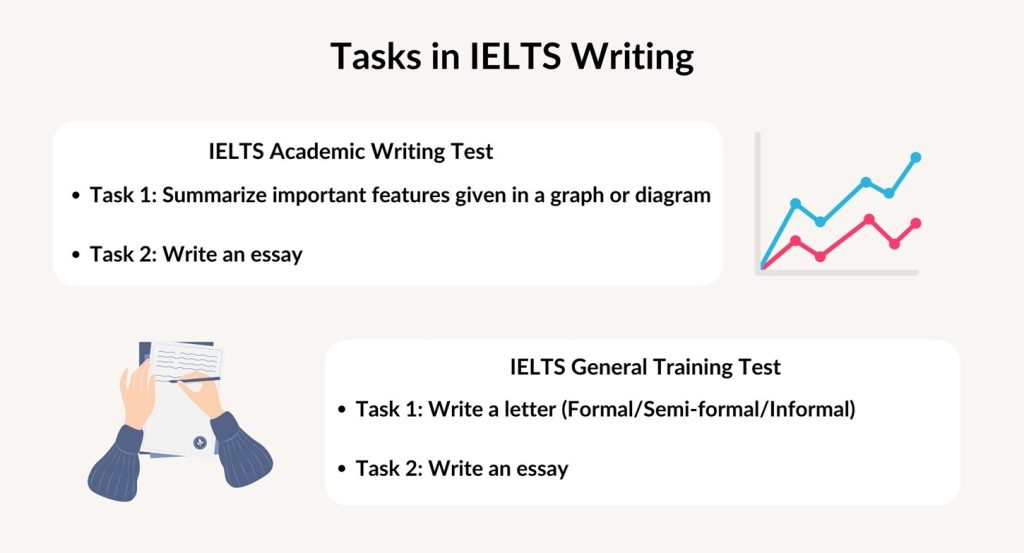
Before diving into the tips, let’s briefly discuss the structure of the IELTS Writing Task. Since the IELTS Academic Writing Task 1 and the General Training Task 1 is different, it is vital that you are familiar with the difference and focus on your respective module. The table below suggests the breakdown of the IELTS Writing task.
| IELTS Type | Writing Task | Description |
| Academic | Writing task 1 | This requires candidates to write a formal essay in response to a given prompt. It assesses the candidate’s ability to present an argument or viewpoint, analyse information, and use appropriate academic language and style. |
| General | Writing task 1 | This module focuses on more everyday situations, such as writing a letter. It evaluates the candidate’s ability to communicate effectively in English for practical purposes. |
| Writing Task 2 [Academic + General Training] | It requires candidates to write an essay in response to a given prompt or question. The essay should be formal in style and well-structured, with an introduction, body paragraphs, and a conclusion. Effective essay planning, organization, and the use of appropriate language and grammar are crucial for achieving a high score. | |
By familiarizing yourself with the different tasks in Writing based on the module, including the IELTS Writing Task 2, you are one step away from acing the exam. Note that you need to acquire the necessary skills to increase your preparation based on the exam type.
Want to learn How to improve your IELTS writing skills immediately?
Tips On How to Improve Your IELTS Writing Band Score
We all know framing complex sentences with the right vocabulary selection isn’t easy, and so this question goes around our mind – How to improve writing skills for IELTS? Whether it is Academic or IELTS General Writing Task 1 or even the Writing task 2, you need to strategise before your exam not only to understand the structure but also to gain the confidence. With the tips mentioned below, your writing skills would surely improve and it will become much easier for you to get the desired band score. So check them out:
Become a Criteria Pro
Thoroughly understand the four criteria used to assess your writing: Task Achievement, Coherence and Cohesion, Lexical Resource, and Grammatical Range and Accuracy. For example, under Lexical Resource, the examiner evaluates your vocabulary range and accuracy of word usage. Knowing this, you can aim to use more varied and precise vocabulary choices throughout your response.
Master Time Management
Proper time allocation is crucial. For Task 1 (20 minutes), spend 2 minutes carefully reading and analysing the prompt, 3 minutes planning, 12 writing your response, and the remaining 3 minutes proofreading and making revisions. For the lengthier Task 2 (40 minutes), double your Task 1 time distribution, ensuring you leave enough time for planning, writing, and reviewing your essay.
Read the Task Twice (or More)
Carefully read the task prompt multiple times to ensure you fully comprehend what is being asked. For instance, if Task 1 requires you to describe a line graph depicting global temperature changes from 1990 to 2023, reread the instructions and analyse the graph thoroughly to understand the specific data trends you need to address in your response.
Outline Your Thoughts
Before you start writing, take a moment to quickly organise your main ideas and supporting details. For a Task 2 essay organise your ideas, and relevant examples or facts you plan to include. This outline will help you organize your thoughts and ensure a well-structured response.
Develop Your Paragraphs
Ensure that each paragraph in your writing has a clear focus and logical flow. Begin with a topic sentence that introduces the main idea, followed by “Present – Extend – Support. Well-developed paragraphs enhance the coherence and cohesion of your writing.
Flaunt Your Vocabulary
Demonstrate your lexical range and precision by using a wide variety of relevant and contextually appropriate vocabulary. Instead of repeating the word “increase” multiple times when describing an upward trend, use synonyms like “surge,” “soar,” “escalate,” or “spike” to showcase your advanced vocabulary skills.
Keep It Simple, Silly!
While using advanced vocabulary is encouraged, ensure that your ideas are conveyed clearly and concisely. Avoid convoluted or overly complex language that may obscure your meaning. For example, instead of stating “Fossil fuels have a deleterious effect on the ecosystem,” it’s clearer and more direct to say, “Fossil fuels adversely impact the environment.”
Mix It Up
Vary your sentence structures to enhance the overall quality and readability of your writing. Combine simple sentences (“The graph shows an upward trend.”), compound sentences (“The graph shows an upward trend, but it plateaus after 2020.”), and complex sentences (“While the graph shows an upward trend initially, it plateaus after 2020 due to the implementation of environmental regulations.”) to create a more engaging and cohesive response.
Punctuate Like a Pro
Pay close attention to punctuation rules to enhance the clarity and flow of your writing. Use commas correctly to separate clauses (“The line graph, which depicts global temperatures from 1990 to 2023, shows a steady increase.”) and avoid run-on sentences that can confuse the reader.
Link Like a Boss
Use appropriate cohesive devices and transition words to create a smooth and logical progression of ideas throughout your response. Words and phrases like “moreover,” “in addition,” “however,” “for instance,” “consequently,” and “nevertheless” can help you effectively connect your thoughts and arguments.
Showcase Your Critical Thinking
Task 2 essays often require you to present arguments and opinions, be sure to analyse and evaluate ideas from multiple perspectives. Provide well-supported examples or evidence, acknowledge counterarguments, and present a thoughtful and well-reasoned conclusion. For instance, in an essay on media censorship, you could analyse the arguments for and against censorship, citing relevant examples or case studies, before offering your balanced perspective on the issue.
Stay on Topic
Ensure that your writing remains focused and relevant to the task prompt at all times. Avoid deviating from the main theme or introducing irrelevant information that may distract the reader from the central topic. If asked to describe a pie chart on energy sources, for example, resist the urge to digress into a detailed discussion of the environmental impact of fossil fuels unless it is directly relevant to the task.
Aim for Balance
When addressing complex or multifaceted topics, strive to maintain a balanced perspective by considering multiple viewpoints or aspects of the issue. For a Task 2 essay on the advantages and disadvantages of remote work, you could acknowledge the benefits (flexibility, reduced commute time) while also exploring the potential drawbacks (social isolation, distractions at home) to present a well-rounded analysis.
Wrap It Up Nicely
Conclude your writing with a clear and concise summary that reinforces your main points or arguments. In an essay response, you could restate your thesis and key supporting ideas, followed by a final perspective, recommendation, or call to action that leaves a lasting impression on the reader.
Proofread, Proofread, Proofread
Carefully review your written responses before submitting them. Check for typos, subject-verb agreement errors (“The data shows…” not “show”), inconsistent tense usage, and any other mistakes that may detract from the overall quality of your writing.
So were you able to find the answer to the question – How to improve writing skills for IELTS? If not, then the next section is going to add further knowledge about writing to your mental repository.
Grammar Tips On How to Improve Your IELTS Writing Band Score
In IELTS Writing, you must note that IELTS Grammar plays a significant role in conveying your ideas clearly, accurately, and effectively.
Vary your Sentence Length
Once you know the different types of sentences, you should practice using them. The most difficult one is the compound-complex sentence, but even if you don’t know that, you can still get a good score with a mix of simple, compound, and complex sentences. The key is varying the length and type of sentence so it sounds natural.
This is an IELTS Writing Task 1 example of an opinion essay:
- Firstly, children watch too much TV. It’s bad for their health. It can make them addicted. They will spend too much time indoors. This can make them fat.
The sentences are all short and could easily be mixed together into more interesting patterns:
- Firstly, children watch too much TV, which is bad for their health. This habit can cause them to become addicted, resulting in them spending too much time indoors and thus getting fat.
Remember Collocations
Students preparing for the IELTS exam always want to study lots of IELTS Vocabulary. This is understandable as vocabulary is important for understanding and making yourself understood. However, knowing a word’s meaning is very different from being able to use it. Learn a word in context and you will be able to apply it more easily. When you are learning vocabulary, pay attention to what words commonly go together.
Avoid using ‘Really, So, A lot, Very’
In your Writing Task, you need to write an essay, using “academic” language. So your goal should be to be reasonably formal/academic. To do so, you should not use imprecise language like really, so, a lot, very, etc
Do not use Contractions in Academic Writing
Contractions are used for Spoken English:
- Don’t > do not
- Can’t > cannot
- Mustn’t > must not
- Couldn’t > could not
- Wouldn’t > would not
- Isn’t > is not
- Haven’t > have not
- Hasn’t > has not
Avoid “There is/ There are”
When you write, try to write your ideas in a clear & concise way. There is/there are is extra words that are not needed. So just leave them out to make your sentences stronger and straight to the point.
- Example:There are many issues that students have to face at university.
- Alternative:Students face a multitude of issues at university.
Know the Sentence Types
It’s really important that you know the difference between a simple sentence and a complex sentence. You don’t need to know the terminology, but it is important that you can form full sentences.
Consistency is the key to improving your writing skills. As you practice regularly, you’ll be well-equipped to achieve your desired IELTS Writing band score. So, let’s take this journey together and get you started!
The IELTS Preparation Centre in Sydney always highly recommends the Cambridge Learner’s Dictionary: Definitions & Meanings to best assist all our IELTS preparation students.
https://dictionary.cambridge.org/dictionary/learner-english/
Other highly recommended links:
Cambridge Thesaurus | Synonyms, antonyms and examples