IELTS Writing Task 2 requires you to write an essay in response to a given general topic. This task in the IELTS exam is designed to assess your skills based on presenting a clear position, developing an argument logically, and organizing ideas coherently. To achieve a high score, you must understand the task format and question types, analyse prompts effectively, and structure your essay appropriately.
Remember that since there are different question types, you need to practice each one of them to become familiar with the specific strategies which need to be used. Most students also find it more difficult than IELTS Writing Task 1.
Let’s check out everything about the IELTS Writing Task 2!
The IELTS Writing Task 2 will prompt you to write an essay for which you will have specific time period. The important pointers of the IELTS test pattern for the Writing Task 2 are given below in the table.
| Topic | Description |
| Task Requirement | Write an essay in response to a point of view, argument, or problem. |
| Assessment | Assesses your ability to present a solution or opinion in a logical, structured way. |
| Duration | 40 minutes |
| Word Limit | At least 250 words |
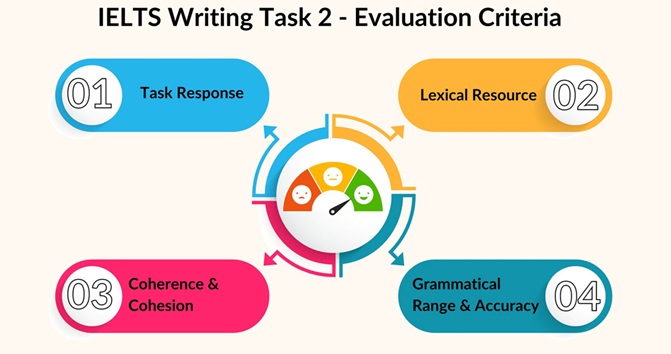
IELTS Writing Task 2 Scoring Criteria
To understand how your IELTS Writing Task 2 essay is evaluated by the examiner, it is crucial to be familiar with the assessment criteria!
| Criteria | Description |
| Task Achievement | Measures how well you address all parts of the task and present a fully developed position. |
| Coherence and Cohesion | Assesses how clearly linked and logically structured your essay is. |
| Lexical Resource | Evaluates your range and accuracy of vocabulary usage. |
| Grammatical Range and Accuracy | Measures the variety and precision of your grammar. |
Band Descriptors IELTS Writing Task 2
Have a look at the table below to learn more about the evaluation criteria!
In the table below, have a look at the IELTS Writing Task 2 band descriptors that will guide you for a top IELTS Band Score.
| Band | Description |
| 9 | · Fully addresses all parts of the task · Presents a fully developed position in an appropriate style with salient supporting details · Well-organized with a logical progression of ideas and cohesive devices |
| 8 | · Addresses all parts of the task · Presents a well-developed response in an appropriate style with relevant details · Logically structured with some cohesive devices |
| 7 | · Addresses all parts of the task · Presents a clear position throughout with relevant details · Logically organized |
| 6 | · Addresses all parts of the task though some parts may be more developed · Presents relevant ideas with some elaboration · Has a clear structure |
| 5 | · Addresses the task only partially with limited development · Presents some relevant ideas but these are limited and not sufficiently developed · Structure is unclear |
| 4 | · Responds to the task only in a minimal way with no elaboration · Presents few ideas, that are largely irrelevant, vague, or repetitive · Lacks logical structure |
| 3 | · Barely responds to the task with irrelevant or vague ideas · Fails to communicate a clear position · Poorly structured |
| 2 | · The answer is completely unrelated to the task · Fails to communicate any relevant ideas · No apparent structure |
| 1 | · No real communication of ideas or position · Totally illegible handwriting or contains only keywords |
| 0 | · No assessment is possible due to illegible handwriting or answers containing only keywords |
Time Management Tips for IELTS Writing Task 2
Since you have only 40 minutes to attempt this question, it is vital to divide the timing so that you can effectively write your answer. The table below suggests the tips for managing time which you can practice by putting the timer on as you prepare.
| Time | Description |
| 5 minutes | · Read the question · Underline/highlight the important parts |
| 5 minutes | · Brainstorm your ideas · Identify the type of the essay · Find keywords according to the topic · Explore the reasons with pointers about justification and examples · Write 5-7 vocabulary words |
| 25 minutes | · Focus on writing the essay according to the structure · Look into the grammatical aspect and sentence structures. |
| 5 minutes | · Proofread your answer and look for any mistakes · Check if there is a logical arrangement of ideas · Watch out for any spelling or grammar mistakes |
Useful IELTS Writing Task 2 Tips
IELTS Writing Task 2 is the second part of the two writing tasks and is one of the most challenging parts of the IELTS test.
- Understand the Task: Test-takers should identify the key components, the question type, and any specific instructions before outlining the key points that should be covered.
- Plan Before You Write: Before diving into the essay, candidates should spend a few minutes planning the response. A clear outline needs to include an introduction, the main points for each body paragraph, and the conclusion.
- Follow a Structured Essay Format:Every essay type has a specific structure. So, sticking to the traditional essay structure with a clear introduction, well-developed body paragraphs, and a concluding summary enhances the readability of the essay.
- Provide Supportive Examples: Test-takers should support their arguments with concrete examples and evidence. This not only strengthens the expressed opinion but also showcases the ability to develop ideas.
- Use Linking Words and Phrases: Candidates should employ linking words and phrases to connect ideas within and between sentences. This improves the overall flow and coherence of the essay.
- Revise and Proofread: This is one of the most vital steps and test-takers need to allocate some time at the end to review and edit their essay. They should check for grammatical errors, clarity, and coherence and ensure that the essay effectively communicates their ideas.
- Practice and write Regularly Under Time Constraints: Practice writing Common IELTS Essay Topics for Writing Task 2 within the 40-minute. This helps improve your time management skills and ensures that you can effectively express your ideas within the given constraints.
Top 8 Common Mistakes to Avoid in IELTS Writing Task 2
- Misunderstanding the Question – Many test-takers misunderstand the question, leading to off-topic essays.
- Poor Time Management – Struggling to manage time effectively often results in incomplete essays.
- Lack of Ideas – Difficulty in generating relevant ideas quickly is a common problem.
- Disorganized Structure – Failing to organize thoughts into clear, logical paragraphs is a frequent mistake.
- Grammar Errors – Frequent grammar errors can significantly lower the writing score.
- Limited Vocabulary – Using a limited vocabulary makes it hard to express ideas effectively.
- Weak Evidence – Providing weak examples usually weakens arguments and doesn’t provide a strong essay.
- Incorrect Word Count – Not meeting the required word count will negatively affect the score.
IELTS Writing Task 2 Question Types
There are 3 main types of questions in the IELTS Writing Task 2 and you may get any one type in your IELTS test. Hence, get to know about them to identify the question prompts effortlessly!
- Argument –In this essay type, you need to state whether you agree or disagree with a given statement and support it with reasons and examples.
- Discussion (Discuss Both Views) – This type requires you to discuss both sides of an issue and then give your own opinion at last.
- Problem/Solution – You have to identify problems related to the topic and suggest possible solutions.
Practice regularly and make writing a habit until your final test! With this preparation, you’ll be ready to achieve your desired band in no time.
The IELTS Preparation Centre always highly recommends the Cambridge Learner’s Dictionary: Definitions & Meanings, to best assist all our IELTS preparation students https://dictionary.cambridge.org/dictionary/learner-english/
Other highly recommended links:
Cambridge Thesaurus | Synonyms, antonyms and examples https://dictionary.cambridge.org/thesaurus/%7B%7Burl%7D%7D
The Oxford Learner’s Dictionary https://www.oxfordlearnersdictionaries.com/us/index.html
Roget’s Thesaurus – Definition, pictures, pronunciation and usage notes | Oxford Advanced
Learner’s Dictionary https://www.oxfordlearnersdictionaries.com/definition/english/roget-s-thesaurus
The Macquarie Dictionary https://www.macquariedictionary.com.au/amember/signup/yi8sTHWX