In IELTS Speaking Part 2, you’ll receive a cue card with a topic for which you will get 1 minute of preparation time and speak continuously for 1-2 minutes until the examiner stops you. This section of the speaking test assesses your ability to speak at length, using appropriate vocabulary, grammar, and discourse structure. Regular practice is key to feeling confident and expressing yourself clearly during this extended response.
It is vital to be aware of the format and assessment criteria in order to achieve your desired band score. You are required to brainstorm your ideas during the preparation time of 1 minute. Remember that consistency is the key to success while building confidence.
Let’s check out the assessment criteria, and a few tips on the IELTS Speaking Part 2!
Understanding IELTS Speaking Part 2
The IELTS Speaking Part 2 is designed to assess your ability to speak for a certain time frame on a given topic which must be from your personal experience. Before starting with the preparation, here’s a concise guide to help you understand Part 2 of IELTS Speaking exam:
- Format: You’ll be given a task card with a topic and points to cover. You’ll have one minute to prepare and then speak for up to two minutes.
- Preparation: Use the minute wisely. Jot down key points and ideas to organize your thoughts. Focus on the prompts on the card to ensure you cover all aspects of the topic.
Speaking and practicing regularly will boost your performance in IELTS Speaking Part 2.
Assessment Criteria of IELTS Speaking Part 2
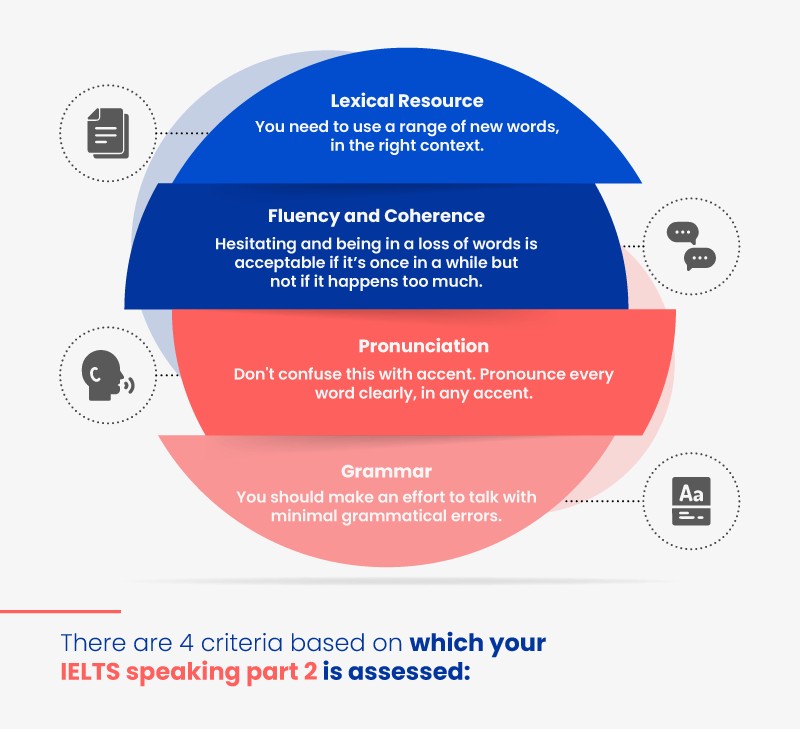
Your IELTS band score for the speaking module is based on 4 criteria:
- Fluency and Coherence – How clearly and logically you speak. Use linking words, extend your answers, speak continuously with appropriate pausing.
- Lexical Resource – Your vocabulary range. Use a wide range of relevant, accurate Vocabulary including idiomatic language.
- Pronunciation – How clear and natural your pronunciation is. Articulate words clearly, use correct stress, intonation and try to be easily understood.
- Grammatical Range and Accuracy – Your grammatical ability. Avoid mistakes and use a variety of advanced grammar structures correctly.
Scores from 0-9 are given for each criteria. The total score is the average of the 4 scores, rounded to the nearest 0.5.
How to achieve a high score in IELTS Speaking Part 2?
Here are top Speaking tips to ace this section:
- Practice Regularly:
- Speak on various topics to build confidence.
- Record yourself to identify areas for improvement.
- Use the Preparation Time Wisely:
- Jot down key points and structure your response.
- Think about examples and personal experiences to include.
- Stay On Topic:
- Focus on the topic given on the task card.
- Ensure you stay on topic within the time limit.
- Expand Your Answers:
- Provide detailed responses with explanations and examples.
- Avoid short, yes-or-no answers.
- Work on Fluency and Pronunciation:
- Speak at a natural pace and enunciate clearly.
- Practice linking words and phrases to improve flow.
- Use a Range of Vocabulary and Grammar:
- Incorporate varied vocabulary and sentence structures.
- Correct minor mistakes and keep talking to show confidence.
Tips for Specific IELTS Speaking Part 2 Topics
Below are some tips for addressing topic-specific questions in IELTS Speaking Part 2:
- Understand the Prompt: Read the topic carefully and identify key points to address.
- Brainstorm Ideas: Take a moment to jot down relevant examples or anecdotes related to the topic.
- Use Descriptive Language: Paint a vivid picture with words to engage the listener and convey your ideas effectively.
- Stay Relevant: Focus on the topic. Keep your response concise and on point.
- Practice Speaking: Rehearse speaking about specific topics to improve fluency and confidence.
Advanced Techniques for IELTS Speaking Part 2
Use Connectors and Linking Words:
- Link your ideas smoothly with Linking Words, such as “however,” “moreover,” and “for instance.”
- This makes your speech more cohesive and easier to follow.
- Incorporate Idiomatic Expressions:
- Use idioms and phrases naturally to show language proficiency. For example, “break the ice” or “hit the nail on the head.”
- Vary Your Sentence Structures:
- Mix simple, compound, and complex sentences.
- This demonstrates a strong command of Grammar.
- Use Examples and Anecdotes:
- Personal stories and specific examples make your speech engaging and relatable.
- They also help illustrate your points clearly.
- Practice Stress and Intonation:
- Emphasize key words and use varied intonation to convey meaning and emotion.
- This makes your speech more dynamic and interesting.
Common Mistakes to Avoid in IELTS Speaking Part 2
Here are five common mistakes students often make during the IELTS Speaking exam:
- Memorizing Responses: Avoid memorizing answers to common topics, like your educational and family background. The examiner can easily spot rehearsed answers, which can negatively impact your score. Focus on demonstrating genuine fluency and understanding.
- Lack of Confidence: Mumbling or not speaking clearly can negatively affect your score.
- Going Off Topic: Stay focused on the given topic. If your response doesn’t address the question, you’ll lose marks.
- Giving Short Yes/No Answers: The IELTS Speaking test evaluates your English proficiency. Providing one-word or yes/no answers makes it difficult for the examiner to assess your skills. Elaborate on your answers to show your language ability.
- Overusing Transition Words: While transition words like “for example” and “on the other hand” are useful, overusing them can waste valuable speaking time. Be concise to ensure you have enough time to discuss the main topic thoroughly.
Brainstorming in IELTS Speaking Part 2
You will only have a minute to brainstorm for which you will be provided with a paper and a pencil.
How to Handle Difficult Questions in IELTS Speaking Part 2?
Stuck in Speaking Part 2? Here’s How to Handle Tough Topics. Don’t panic! Even if you get a tricky question:
- Buy Time: Ask for clarification if something’s unclear. A moment to think can help.
- Start Basic: Begin with a simple answer, then add details as you remember them.
- Relate it Back: If you can’t think of a specific example, connect the topic to something familiar.
- Be Honest: Let the examiner know you’re taking a moment to gather your thoughts.
- Keep Talking: Avoid silence. Even if you say “um” or “well,” it shows you’re still thinking.
Remember, the examiner wants to see how you handle challenges. Stay calm, and keep talking!
With the right strategy, you will be able to make yourself become familiar with the structure used in the IELTS Speaking Part 2. Remember with each cue card, you are taking one step towards success.
The IELTS Preparation Centre always highly recommends the Cambridge Learner’s Dictionary: Definitions & Meanings, to best assist all our IELTS preparation students https://dictionary.cambridge.org/dictionary/learner-english/
Other highly recommended links:
Cambridge Thesaurus | Synonyms, antonyms and examples https://dictionary.cambridge.org/thesaurus/%7B%7Burl%7D%7D
The Oxford Learner’s Dictionary https://www.oxfordlearnersdictionaries.com/us/index.html
Roget’s Thesaurus – Definition, pictures, pronunciation and usage notes | Oxford Advanced
Learner’s Dictionary https://www.oxfordlearnersdictionaries.com/definition/english/roget-s-thesaurus
The Macquarie Dictionary https://www.macquariedictionary.com.au/amember/signup/yi8sTHWX