IELTS Pen and Paper Test: Everything You Need to Know
Explore every detail of IELTS pen and paper test before deciding on which mode of exam you should take. This article will help you make your final decision.
Enrol at the IELTS Preparation Centre in Sydney and learn how to more easily achieve your IELTS grade with native speaking examiners as your teachers.
With the advancement of technology, most important services, from education to healthcare, are shifting to the online mode. The same thing happened with international exams like IELTS as well. In spite of that, many candidates still prefer the traditional IELTS pen and paper test.
So, to familiarize the IELTS candidates with this mode of exam and help them start their preparation accordingly, this article will provide the much-needed pen and paper-based IELTS exam test details.
Details on the IELTS Pen and Paper test
The cost of registering for the IELTS exam, whether it is for pen and paper or computer-based tests, is the same.
There have been very few revisions/updates on the pattern of IELTS until now.
Therefore, without wasting further time, let us check out the IELTS pen and paper test pattern, question types and marking pattern of IELTS Pen and Paper test.
Format of IELTS Paper-based Exam
In the paper-based IELTS mode, candidates will have to take the Reading, Listening, and Writing tests at a desk with question papers and answer sheets in an authorized IELTS test center.
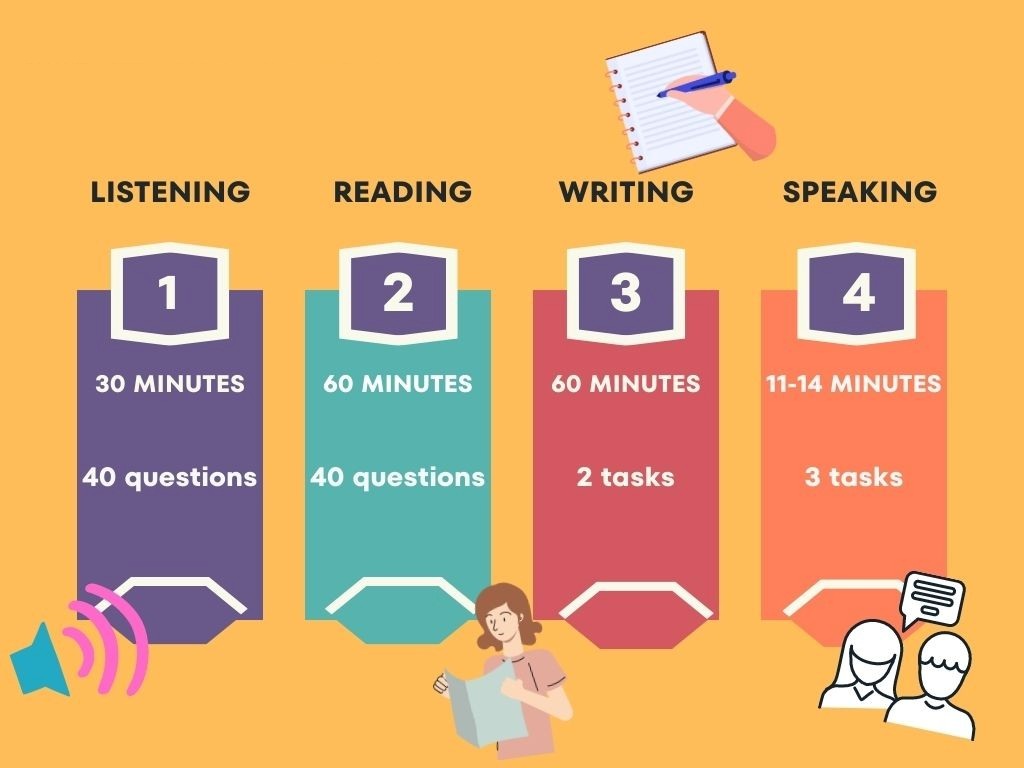
The duration for Writing and Reading modules is one hour each, while Listening takes approximately 40 minutes and Speaking takes a maximum 14 minutes.
- As per the update applicable from 25th June, 2022, the sequence of the IELTS pen and paper test is Writing, Listening, Reading and Speaking. This sequence is also being followed for the Computer-based IELTS exam.
- The responses must be written on the answer sheet with HB pencils or a pen.
- A trained IELTS examiner will work with you one-on-one during the Speaking examination.
Question Types Given in IELTS Pen and Paper Test
The types and number of questions for IELTS are the same for Paper-based and Computer-based IELTS.
How is Paper-Based IELTS Scored?
The scoring for the IELTS exam is done on the basis of a band score of 0-9.
- The Listening and Reading is marked out of 40.
- One mark is allotted for each of the 40 questions.
- The Writing and Speaking sections have their own set of criteria based on how the examiner assesses the tasks.
Each module is scored on the basis of a 0-9 band score, which is used to calculate the overall band score.
Results of IELTS Pen and Paper Test
The IELTS Pen And Paper Test Results are available on the website of IDP according to the mode of exam that the candidate has taken.
- For the IELTS pen and paper test, the results are available within 14 days after the exam has been completed.
- The results are valid for two years from the date of publication and can be used to apply for universities and immigration to various countries.
Rules to Follow for IELTS Pen and Paper Test
There are certain IELTS paper-based test rules that every candidate must follow while taking the IELTS Pen and Paper test. Let us mark them all to avoid disputes during the IELTS exam.
IELTS Paper-Based Test Rules for Listening, Reading and Writing
The following are the rules for the first three modules that take place in the morning:
- After completing check-in procedures, candidates are not permitted to leave the hall unless they are accompanied by an invigilator.
- During the test, candidates are permitted to leave the room on their own schedule, although they must be escorted by an invigilator.
- You should keep your ID, pencils, pens, an eraser and a pencil sharpener on your desk. Other items will not be allowed inside the exam hall. Many centres now provide these, so it is best to check when you make your exam booking.
- Once the exam has begun, you can speak to the invigilators only.
- Raise your hand if you need to speak with an invigilator, and one will come to you.
- Notify an invigilator right away if your question papers contain any errors.
- As soon as the test’s invigilator declares that the exam is over, you must stop writing. Otherwise, you will be removed from the exam if you don’t cooperate.
- At the conclusion of the Listening, Reading and Writing exams, you must turn in all exam papers, including any unused writing paper, to the invigilator.
IELTS Paper-Based Test Rules for Speaking
The rules given below are to be kept in mind for IELTS Speaking, which usually takes place in the afternoon after the first three exams:
- Carry your identification, as it will be inspected at the speaking registration room.
- You will also have your finger scan examined to confirm your identity.
- You have to keep your belongings other than the above-mentioned documents in the cloakroom before you enter the speaking registration room.
- Make a mental note to reach the speaking test registration room 30 minutes before the test is due to start. Candidates who arrive late for their speaking examination may miss out on their Speaking exam.
- Unless the examiner confirms your identification, you cannot take your IELTS Speaking test.
- After your exam is over, take your belongings from the cloakroom and leave the premises. If you are found discussing the exam with someone, you might be disqualified.
Advantages and Disadvantages of IELTS Pen and Paper test
In order to choose the preferred mode of taking the IELTS exam, candidates need to know the pros and cons. So, given below are the advantages and disadvantages of the IELTS paper-based exam.
Advantages of IELTS Paper-based Exam:
- Candidates can fully concentrate on the tasks at hand because they don’t need to have or develop their fundamental computer abilities.
- Before they write the words on the response sheet, students can quickly underline and circle words on the question paper. This is a common approach for many candidates, but it is impossible if they want to take the computer-based IELTS test.
- After listening to the whole audio in the Listening part, candidates receive an additional 10 minutes to transfer their answers to the answer sheet. For numerous students, this is a blessing.
- It is not necessary for candidates to be accustomed to typing responses. Consequently, many test-takers appreciate the ability to write, particularly in the Writing section.
Disadvantages of IELTS Paper-based Exam:
- It is time-consuming as candidates must keep track of the words they write and it may be difficult to edit or change the answer.
- If you are not focussed, it may be easy to make errors when transferring responses into the answer box.
- Publication of results requires more time than the other modes.
The IELTS Preparation Centre in Sydney always highly recommends the Cambridge Learner’s Dictionary: Definitions & Meanings to best assist all our IELTS preparation students
https://dictionary.cambridge.org/dictionary/learner-english/
Other highly recommended links:
Cambridge Thesaurus | Synonyms, antonyms and examples
https://www.oxfordlearnersdictionaries.com/us/index.html